Gadgets
Smartphones of the Future: Which Technologies Will Change Mobile Devices in the Coming Years

The smartphone stopped being just a phone long ago: it is a camera, a wallet, a work computer and a personal assistant in one body. It might seem that the market has reached a plateau in recent years — models from different brands look alike, and upgrades are becoming less noticeable. Yet the industry is undergoing a major overhaul, and over the next five years it will change not only what is inside our devices but also how they look.
Here are the key technologies that have already left the lab and will soon define the phone in our hands.
Flexible and rollable displays
Foldable smartphones have gone from expensive experiments to a mature category. Hinges have become more reliable, the crease is almost invisible and the bodies are thinner. The next step is rollable and stretchable screens: the display slides out of the body, turning a compact phone into a small tablet with no crease in the middle.
Protection technologies are developing in parallel: ultra-thin glass (UTG), self-healing coatings and more energy-efficient tandem OLED panels that last longer and are less prone to burn-in.
Artificial intelligence on the device
The main trend of recent years is moving neural networks from cloud servers to the smartphone itself. Modern processors include powerful neural processing units (NPUs) capable of running compact language models locally. This brings three benefits:
- Speed — translation, speech transcription and photo processing happen instantly, even offline.
- Privacy — personal data never leaves the device.
- Context — the assistant understands what is on the screen and carries out multi-step actions across apps.
In the coming years AI will become the foundation of the interface rather than a separate feature: instead of hunting for the right menu, users will simply describe the task.
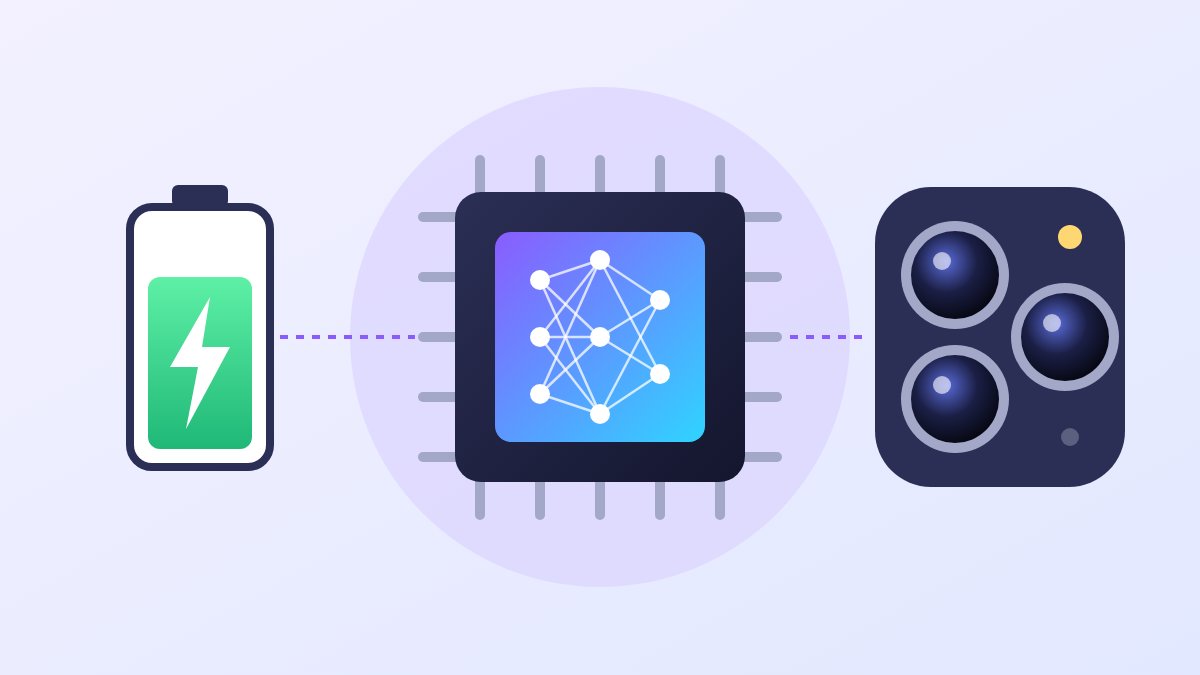
New batteries: silicon-carbon and solid-state
Lithium-ion battery capacity grew slowly for a long time, but silicon-carbon anodes are changing that: they pack more energy into the same volume, and phones with 6,000–7,000 mAh batteries at a normal thickness are already on the market.
The next frontier is solid-state batteries, which use a solid electrolyte instead of a liquid one. They are safer, handle fast charging better and degrade more slowly. The technology will first reach electric vehicles at scale and then wearables and phones.
Cameras: computational photography and periscopes
The physical size of a smartphone sensor is limited by the thickness of the body, so manufacturers are betting on algorithms. Computational photography merges dozens of frames into one, and generative models help restore detail when using digital zoom. Periscope modules with variable focal length provide high-quality optical zoom, and 1-inch sensors are becoming standard for flagships.
Another direction is under-display cameras, which will remove notches and cut-outs, and multispectral sensors that reproduce colour more accurately.
Next-generation connectivity: satellites, 5G-Advanced and 6G
Satellite connectivity in smartphones already works for emergency messages and in the coming years will be available for ordinary texts and data where there are no towers. 5G-Advanced networks will raise speeds and reduce modem power consumption, and in the early 2030s the move to the sixth generation will begin — read more in our article “6G Technology: How the Next Generation of Mobile Networks Will Differ from 5G”.
Security and longevity
A smartphone stores everything, from bank cards to digital documents. That is why manufacturers are introducing hardware secure enclaves, next-generation biometrics (ultrasonic fingerprint scanners, 3D face recognition) and post-quantum encryption algorithms. Regulators also demand repairability and long-term support: many flagships already receive updates for seven years, and the EU is introducing requirements for replaceable batteries.
What this means for buyers
- When choosing a flagship, look at NPU performance and the length of software support — these matter more than the megapixel count.
- Consider a foldable if you work a lot with documents and video: the technology is mature enough for everyday use.
- Don’t chase the “first wave” of new technology — the second generation is usually more reliable and cheaper.
Frequently asked questions
When will rollable smartphones go mainstream?
Prototypes have already been shown, and the first production models are expected in the coming years. The form factor will become mainstream once the sliding mechanism gets cheaper and proves its reliability.
Will an AI assistant replace familiar apps?
Not entirely, but a large share of routine tasks — bookings, messaging, finding information — will be done through voice and text requests to the assistant.
The smartphone of the future is not one revolutionary feature but a combination of a flexible form factor, local artificial intelligence, higher-capacity batteries and ubiquitous connectivity. Many of these technologies are available today, and by the end of the decade they will be standard even in mid-range devices.