Connectivity
6G Technology: How the Next Generation of Mobile Networks Will Differ from 5G
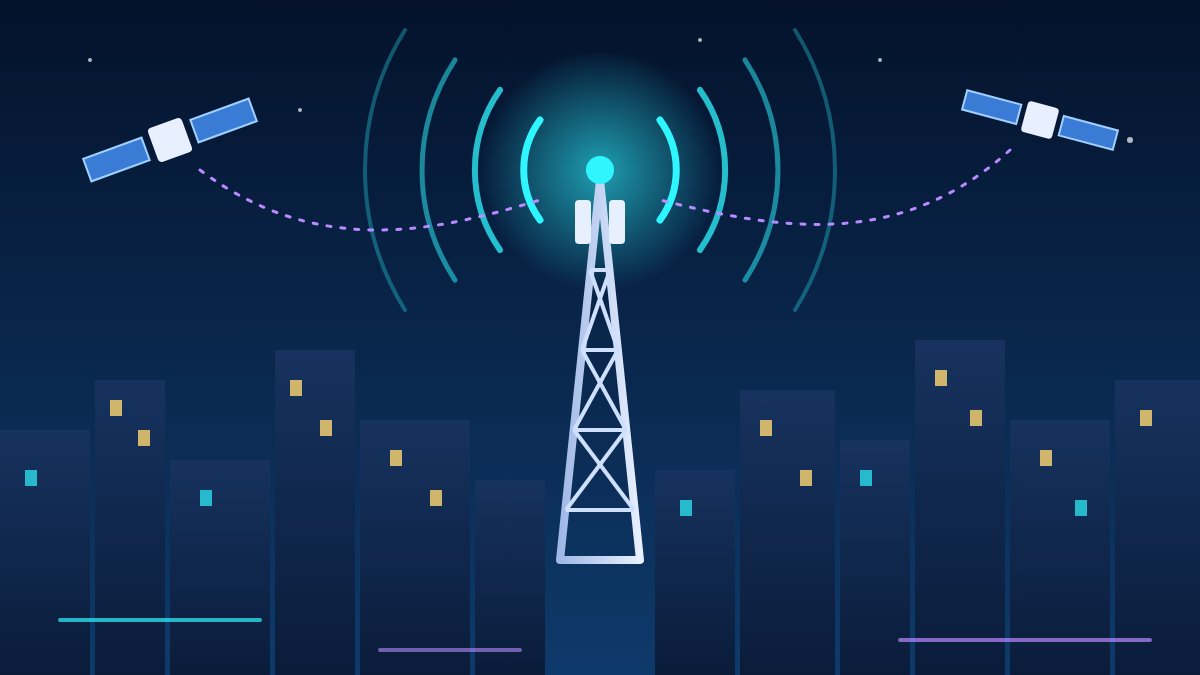
Fifth-generation networks are still being rolled out around the world, yet engineers, researchers and regulators are already working on the next step — 6G. The new generation of mobile communication promises not just higher speeds but a fundamentally different role for the network: it will become the “nervous system” of the digital world, combining connectivity, sensing and artificial intelligence.
Let’s look at when to expect 6G, how it will differ from 5G and what challenges must be solved before launch.
When will 6G arrive?
Mobile generations change roughly once a decade. In 2023 the International Telecommunication Union (ITU) approved the IMT-2030 framework — the high-level requirements for 6G. The 3GPP consortium, which develops mobile standards, has started the study phase within Release 20, and the first 6G specifications are expected in Release 21 around 2028–2029. Most operators forecast commercial launches around 2030.
Key differences between 6G and 5G
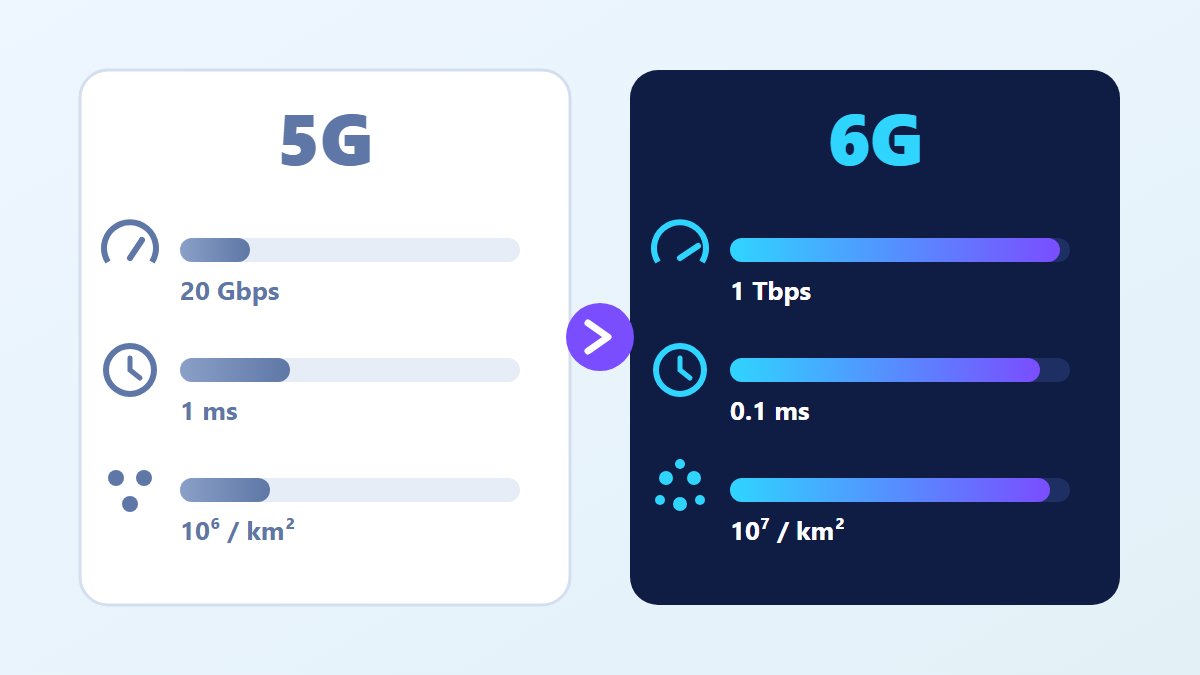
Below is a comparison based on the target figures discussed by researchers and standards developers. Final values will be set during standardisation.
| Parameter | 5G | 6G (targets) |
|---|---|---|
| Peak data rate | up to 20 Gbps | 100 Gbps to 1 Tbps |
| Latency | about 1 ms | down to 0.1 ms |
| Device density | 1 million per km² | up to 10 million per km² |
| Spectrum | below 6 GHz and millimetre waves | plus 7–24 GHz and sub-terahertz bands |
| Positioning accuracy | about a metre | centimetres |
| Role of AI | supporting | built into the architecture (AI-native) |
| Coverage | mostly terrestrial | integrated with satellites and HAPS |
New spectrum: from upper mid-band to terahertz
Huge speeds require wide frequency bands. The main “workhorse” band for 6G is likely to be the upper mid-band of 7–24 GHz, which combines good capacity with acceptable range. For ultra-fast short-range links, researchers are exploring sub-terahertz frequencies (100–300 GHz). These can carry hundreds of gigabits per second but are easily blocked by walls and even foliage, so they will require a dense network of small cells and reconfigurable intelligent surfaces (RIS).
A network that can see: integrated sensing
One of the most unusual ideas in 6G is ISAC (Integrated Sensing and Communication). Base station radio signals will not only carry data but also work like radar, detecting the position, speed and shape of objects. This will enable new services — from traffic monitoring and drone navigation to gesture recognition and camera-free breathing monitoring.
Artificial intelligence at the core of the network
While 5G uses machine learning in specific places, 6G is being designed as an AI-native network. Neural networks will manage radio resources, predict load, save energy and fix faults automatically. The network itself will become a platform for distributed computing, with AI models running at the network edge, closer to the user.
Coverage without blind spots
6G will combine ground stations, low-orbit satellites and high-altitude platforms (HAPS) into a single system. A smartphone will switch between them automatically, providing connectivity in the mountains, at sea and on planes. The first steps have already been taken: satellite messaging has arrived in modern smartphones.
What 6G will change in everyday life
- Holographic and immersive communication — video calls with 3D images and lag-free XR.
- Digital twins — accurate real-time virtual copies of factories, cities and power grids.
- Autonomous transport — data exchange between vehicles and infrastructure with minimal latency.
- Healthcare — remote diagnostics and health monitoring through wearable sensors.
- Smart homes and cities — millions of sensors running for years without battery changes; see what this already looks like in our article on the smart home in 2026.
Challenges on the road to 6G
Engineers have plenty to solve: energy-efficient chips for terahertz bands, cheaper dense small-cell networks, international spectrum harmonisation and security — including resilience against future quantum computers. Energy efficiency matters too: 6G must carry more data while using less energy per bit.
Frequently asked questions
Will I need a new smartphone for 6G?
Yes, using 6G networks will require a device with a suitable modem. But the transition will be gradual: 5G and 6G will operate side by side for a long time.
Are 6G’s high frequencies dangerous to health?
Mobile radio waves, including the terahertz range, are non-ionising. Equipment must comply with international exposure limits, which are set with a wide safety margin.
6G is an evolution from “fast internet” to an intelligent infrastructure that combines connectivity, computing and perception of the world around us. Mass deployment is still a few years away, but the decisions being made now will shape how we live and work in the 2030s.